Recently a student of mine wrote to me after a class….
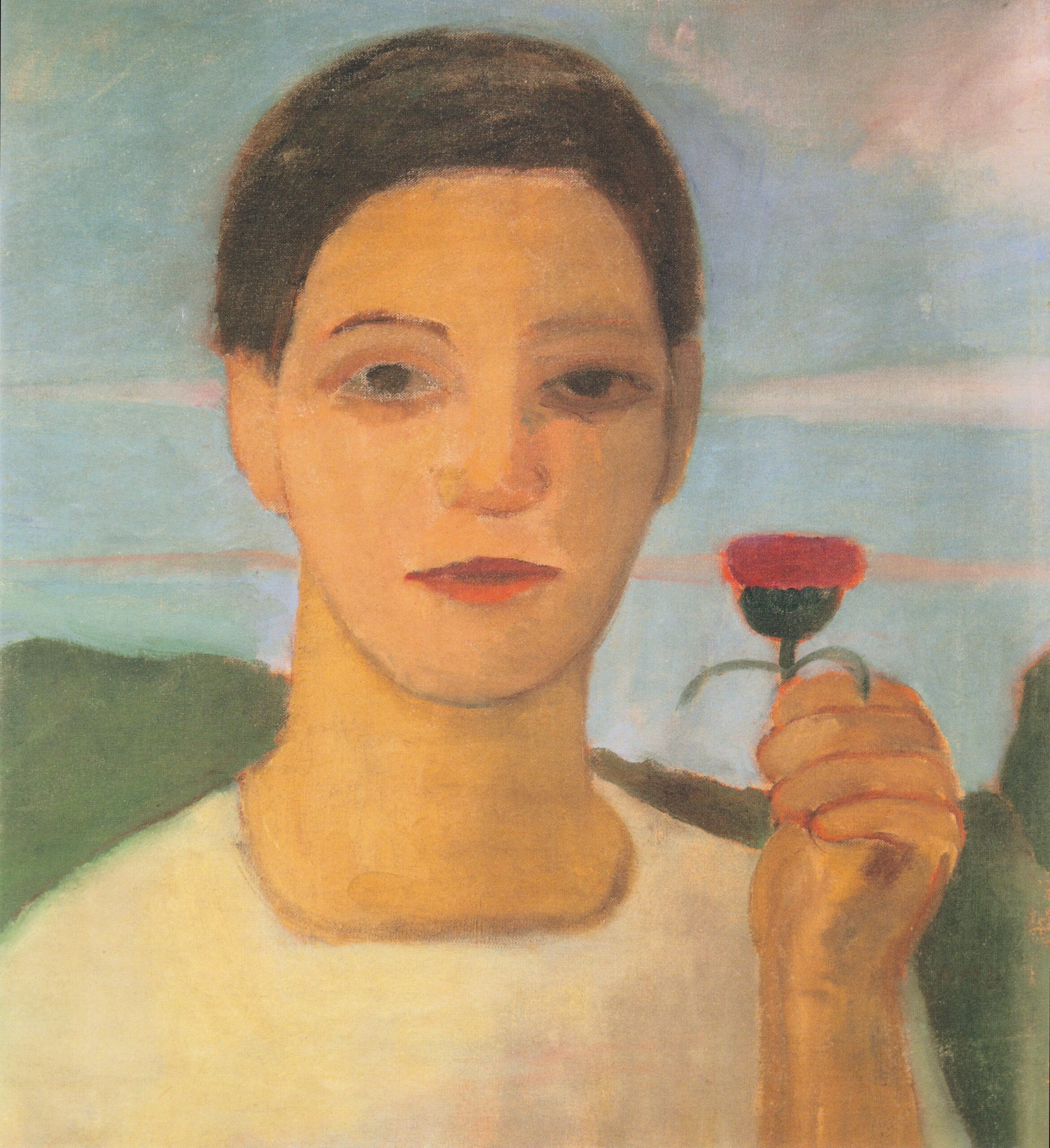
“I want to say that I think that by you researching and presenting the show to us of Paula Modersohn- Becker, you honor and help her (and her artwork) live on – past her short life. It reminds me of Family Constellation work in that we can change the past and affect the future stories through our inner work.”
I thought this this was a wonderful and provocative comment, not totally graspable like poetry. I wrote back….
“I believe these artists awaken or keep alive something humanity is losing. The paintings are like magical talismans that reorient our psyche’s…..”
It’s fascinating to contemplate the various routes that viewing art takes to transform and reconnect ourselves to what’s true and undying. The mysterious transmission of feeling and spirit from a painting to people born at a much later time is both fascinating and magical. Sometimes just looking can unlock inner truths that are dormant and need activation for the purpose of an individual’s evolution. If we allow ourselves to dialogue with those images and feelings through creative expression, this becomes a modality of finding what’s needed, the textures, colors and forms become the visitors, the angels of healing.
I wonder though what kinds of paintings and art works elicit the response that my student wrote to me about. Some artworks tap into our imaginal, archetypal and spiritual bodies through an emotional response or a feeling of transcendence. It may be that a particular image signifies or triggers a complex of unconscious emotions or memories. This multi layered response has been integral to the experience of looking at art up until fairly recently.
Within the complexity of forms that modern and postmodern art have taken some of this multi layered response has been diluted if not completely negated.
The early Modernist movement in Europe (approx. 1880–1930) was based on a reorientation to a deeper engagement with life, the psyche and a recognition that mankind was at a precipice. A place where we risked losing our essential humanness to the onslaught of technological, industrial and cultural change.
True visionaries are always way ahead of their time. William Blake (early 1800’s) countered the ugliness of his age through his divinely inspired imagery, prose and poetry. Later on the symbolist movement of the mid to late 19th century led by Gustav Moreau, Paul Gauguin and Odilon Redon opened the gates to primitivism, mysticism and the modes of personal inner expression that turned over the old traditional ways and led to a rejuvenation in painting.
It wasn’t only the painters but the poets and writers of that era like Baudelaire, Rimbaud, Verlaine, Apollinaire, Mallarme and later Rilke that inspired and complemented a movement that had impregnated all the arts. As modernism played out into a new century through the many ‘isms’, Fauvism, Cubism, Orphism, Surrealism, up into Abstract Expressionism there was I believe a prevalent view that art could affect transcendence and the spiritual. Not only through the evocation of beauty but through awakening archetypes, psychological insight and the subconscious. Theosophy was in the air in the European art capitals and there was a spiritual thirst in the midst of the dominant materialist view.
Modernism doesn’t have a definable period. Some say it ended in the late 20th century or before, others say late modernism is still a living movement. But at some point the Modern movement was challenged by the highly ambiguous term Postmodernism and with that something shifted in a fundamental way. At least in academia, art was now divorced from its primordial wellspring, the spiritual.
After the second world war U.S. art collectors, curators and academics created a powerful taste making force. Highly spiritual artists like Agnes Pelton (1881-1961) who had popularity in the 1930’s we’re virtually erased from art history. A secular highbrow culture out of the art capital of N.Y.C. dominated discourse through the 50’s, well into the late decades of the century. The word ‘God’ became a sort of taboo in serious art circles.

It’s ironic that one of the prophets of the so-called secular Modernist movement, Wassily Kandinsky, was deeply religious. His art was filled with hidden mystical references related to his Christian faith. He thought that the separation of high art and low art was an artificial concoction. In their famous co-operative publication, The Blue Rider Almanac, (pub.1912) Kandinsky and his collaborators presented artworks from non-European nations, primitive art, folk art and modern art together with the most dominate artists in the publication, children!
“Art is born from the inner necessity of the artist in an enigmatic, mystical way through which it acquires an autonomous life. It becomes an independent subject, animated by a spiritual breath.” Wassily Kandinsky
As we look back at early Modernism and the fuzzy birth of the Postmodern era, we can see in hindsight just how much was lost. I’ve never seen an adequate definition of Postmodernism. I define it is as a sort of negation, the end of the romantic view, the divesting of meaning from form, replaced by irony and a predominantly intellectual approach to art. An over reliance on language for art to have meaning vs. the intuitive, emotional and simple aesthetic response to art. The art writer and academic historian Camille Paglia said it bluntly probably decades ago…. ”The art world will never revive until postmodernism fades away. Postmodernism is a plague upon the mind and heart.”
Now we have a new term coming into cultural parlance, Metamodernism.
“Metamodernism is what we get when we take the strategies associated with postmodernism and productively reduplicate and turn them in on themselves. This will entail disturbing the symbolic system of poststructuralism, producing a genealogy of genealogies, deconstructing deconstruction, and providing a therapy for therapeutic philosophy.”
Storm, Jason Ānanda Josephson (2021). Metamodernism: The Future of Theory. University of Chicago Press.
I was hoping that it would also provide therapy for people without PhD’s who can’t understand this jargon. I don’t find that ‘art speak’ or academic rhetoric ever spoke to a very wide audience of artists or art lovers. After a light foray into the term my understanding is that Metamodernism includes features of both Modernism and Postmodernism. Which sounds like a strange contradiction to me. It’s good to keep in mind that most of the early and late modern artists (that I’ve researched) were loath to identify themselves with any ‘ism’ at all. A sentiment that the academic artworld never wanted to publicize much.
”You cannot explain me with “isms.” They are very bad for an artist. What one must believe in is color.” Marc Chagall
I would agree Marc, but it seems we are stuck with these terms as ways to categorize and talk about art historically. I am a big fan of the so-called Modernist movement but not the one I learned about in art school. The movement was richly multi-faceted, celebrating experiment, play, the mystical and the transgressive. I was surprised to learn that so many of the early Moderns were influenced by Madame Blavatsky (Theosophy) and Rudolph Steiner (Anthroposophy). My art education celebrated the transgressive (Marcel Duchamp, Dada, etc.) but pretty much excluded the spiritual underpinnings of Modernism.
As therapeutic modalities like art therapy and ‘process’ artmaking become more mainstream perhaps a more fluid view of what it means to be an artist will take root. Anyone can create art no matter what kind of training or background they have and its value is determined solely by the one who perceives it. I’m not talking about monetary value of course which is based on fashion and the marketplace. Art that relies primarily on language and concepts for its meaning isn’t any more valuable than art that speaks only from its forms and the feelings they elicit. On the contrary, the mute artist and artwork should be celebrated not devalued. Hierarchies of meaning stifle artistic expression.
Just as anyone can be an artist, people at any level or skill set can appreciate the artistic masters of earlier eras whose work continues to resonate through time. Everyone loves beauty and we can all learn to become more sensitive to its infinite manifestations. This is what I advocate for and encourage. The breakdown of hierarchies and compartmentalization and the receptivity to the widest range of creative expression. Great art calls us not through concepts but through feeling. And the word ‘feeling’ is too vague to actually get at the roots of the mystery.
It’s virtually impossible to distinguish the range of those feelings that arise when viewing art and that’s a good thing. At times the numinous is present. To repeat what my friend and student said to me after looking at the work of Paula Modersohn-Becker…”It reminds me of Family Constellation work in that we can change the past and affect the future stories through our inner work”. Perhaps she meant that inner work is happening while making and also while viewing art and maybe that in some way our interaction with those images contributes to a collective form of psychic/emotional healing.

Her statement reminds me of what Pierre Bonnard said…” Painting has to get back to its original goal, examining the inner lives of human beings.” Which to me seems truer now than ever.
I immediately think of so many great artists of the past Johannes Vermeer, Odilon Redon, Bonnard, Vuillard, Romare Beardon, Picasso, Helen Frankenthaler, Mary Cassat, Agnes Pelton, El Greco, Titian, Goya and Van Gogh, to name a few. Their sincere engagement with life, color, form and feeling make these artists mystics in my book. They were looking deeply into the human condition, inspiring a sense of mystery, awe and fascination.
“All our interior world is reality, and that, perhaps more so than out apparent world.” Marc Chagall.
The art scholar and philosopher Ananda Coomaraswamy said….. “I suggest that the vison of even the original artist may be rather a discovery than a creation. If beauty awaits discovery everywhere, that is to say that it waits upon our recollection (in the Sufi sense and in Wordsworth’s): in aesthetic contemplation as in love and knowledge, we momentarily recover the unity of our being released from individuality.”
There are a lot of different definitions of the word ‘mystical’ these days but my definition is akin to what Coomaraswamy states above. To recover the unity of our being released from the delusion of ego is the movement or rather the recollection of our natural state. It’s the same aspiration for unity that pervades every mystical sect in all religions and spiritual paths. If that seems like a romantic notion in these times when applied to the arts at least it’s a very old one. You can see it in the cave paintings at Lascaux and in painting all the way up through the modern and so called metamodern era of today. If there is ever to be a rejuvenation of culture and the arts it will come about by a return to the silent mystical dimensions that artists all down through history have explored.
This cultural remembrance or rebirth is already underway as the old world crumbles and a new one rises from the remains.
Top Image: Paula Modersohn-Becker, “Portrait of Sister Herma with artichoke blossom in her raised hand” 1906, oil on canvas, 56.5 by 51 cm.
Middle Image: Agnes Pelton, Being, 1926, oil on canvas, 26 by 22 in.
Lower Image: Pierre Bonnard, The Open Window, 1921, oil on canvas, 46.5 by 38 in. The Phillips Collection, Wash. D.C.