MICHAEL ZIEVE | Fine Artist & Educator

Header - Michael Zieve | Fine Artist & Educator

Search Artwork

May 16, 2025

Uncategorized

Intuitive Art Process And The Appreciation Of Beauty

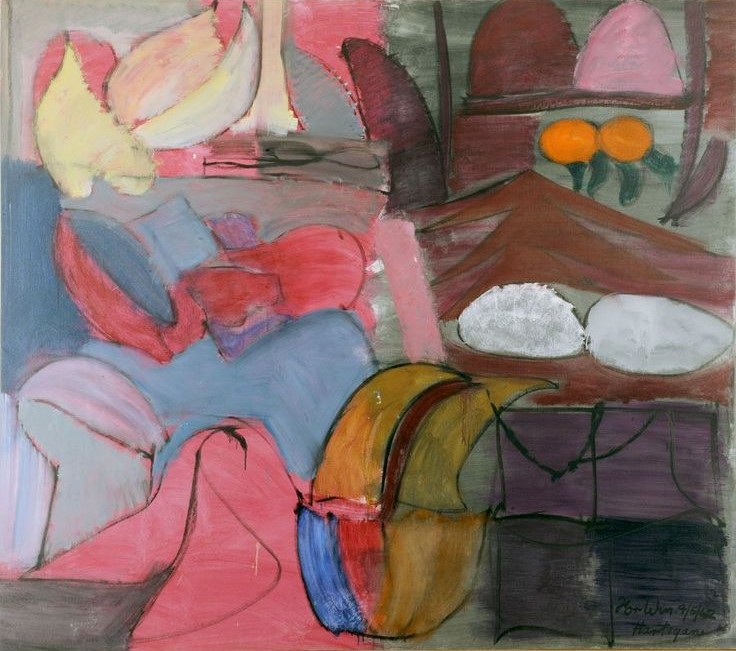
What is intuitive process artmaking? The great painter Grace Hartigan said it simply…” I am a process artist…you start out with an idea; ideas keep coming as your creating and eventually the painting tells you what it wants.” An idea can be the impetus for the painting but is not intended to be the end point. It’s the creative process itself that gets full permission to take whatever turns it wants, often bringing the artist to a place of surprise and amazement. Some process teachers tell their students that beauty has nothing to do with this process because the intention to make something beautiful can derail the process which is after truth and not necessarily beauty. Beauty, of course is in the eye of the beholder, in my mind if a work has the ring of truth or is an authentic expression of the heart it is naturally a thing of beauty. But beauty in the traditional sense of the word is not something to be averse too either. My observations over the years in process painting studios tells me that sometimes an artist suffers from too little input from the outside. The result can be repetition and an over reliance on ones limited visual vocabulary. In my classes I offer a middle ground between process art making, aesthetic appreciation and dialoging with imagery. We create a safe container grounded in deep listening to help open the intuitive heart. For me our inherent thirst for beauty naturally dovetails with the longing for expressive freedom and spiritual inquiry. As an art school graduate and longtime artist, the process approach opened me to the joy of making art from my child’s eye perspective and brought my awareness to the judgements that held back my creativity and blindsided me to my habitual choices. This training or untraining was invaluable to me but it did seem to have its limitations. I observed an unconscious conformity of style in many process painting classes although the work was more often than not wonderfully rich in emotional content. How does one keep that valuable content while opening up the gates to a wider cast of influences, formal qualities, painting modes and movements that most untrained or even trained artists are not aware of? One of my art professors used to say “As an artist you don’t live in a vacuum”. He was preaching the importance of visual vocabularies and aesthetic appreciation of artwork whatever their source from pop culture to ‘outsider’ artists, to great masters of the past. I value the exposure I’ve had to master artists of the past not all of them trained artists and feel I have something to offer those who would like to learn more about how to appreciate the language of painting. In my online classes I use the work of great artists as inspiration that can sprout new ideas for students. We can’t do it all though so we pick and choose the influences that appeal to our individual temperament and this can vary over time. Art that does not relate specifically to our work of the moment still informs our hearts and minds and can awake something in us that may blossom further down the line. Unpredictable relationships happen when we see work that is outside our limited purview. We are inspired to grow into ourselves by seeing what others have done in the past. If you’re an amateur or untrained artist you usually allow yourself freedom to grow and experiment, on the other hand many professionals, by virtue of their connection to the market place find that to be challenging. Trained artists and professionals can benefit from dipping into that place of freedom and experimentation. We live in an unprecedented time where exposure to great art from the past and from a variety of cultures is there at our fingertips on the keyboard. The danger of this easy access is that we become overwhelmed by brilliant works of the past and present that can inhibit our native imagination. The balance hangs between the two extremes of overexposure to inspiring art and the limited palette of our own inventions. There are seasons in our artistic life that naturally move within this spectrum of opening out and honing our personal craft. Ultimately, I’m not alone in thinking that appreciating beauty is a key element of psychological wellness. It lifts us up and inspires us. If we ignore the gifts of our artistic legacy from other times, we impoverish ourselves as artists and as a culture. As the artist and writer Martin Prechtel say’s, in these dark times our task as artists/artisans is to preserve the seeds of all the arts that have been passed down to us for a future time when humanity has the opportunity to appreciate them and bring them more fully into flower. One of these arts is the ability to see, feel and understand artwork and thereby enhance our creative imagination. The world thirsts for the soul’s authentic and uniquely personal expression. Recognizing our deepest self in making and/or appreciating art opens us to the great universal heart and therein lies the power of it’s alchemy. Top Image: Grace Hartigan, The Dream, 1962, oil on canvas
Uncategorized

On Jewels of a Higher Order

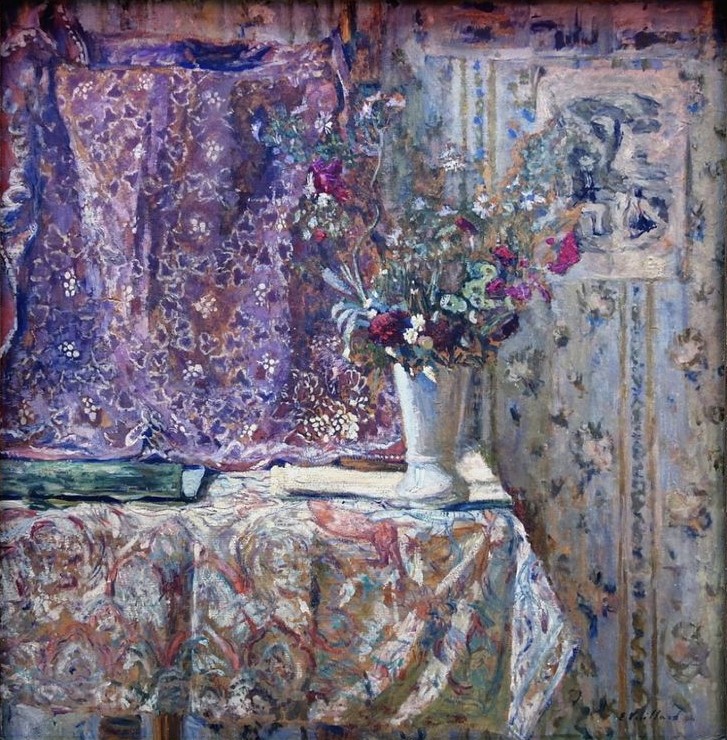
“In Vuillard’s interior every detail however trivial, however hideous even- the pattern of the late Victorian wallpaper, the art nouveau bibelot, the Brussels carpet is seen and rendered as a living jewel: and all these jewels are harmoniously combined into a whole which is a jewel of a yet higher order of visionary intensity.”      This quote is from the remarkable essay ‘Heaven and Hell’ by Aldous Huxley, published in 1954. He’s referring to the great French painter Edouard Vuillard, 1868-1940. For Huxley, Vuillard’s painting is a vehicle that transports us into a heightened sense of reality, one akin to visionary or mystical experience and this experience, which one might call aesthetic rapture, is a deeply rooted need in the psyche of man.  He goes on to say that this need has been the impetus for artmaking since the beginning of our species history. It transcends cultural considerations, civilized or uncivilized, colonized or free indigenous cultures. I believe it’s important when viewing and creating art to recognize that art satisfies a basic human drive. It arises out of the imagination (whether personal or collective) and not primarily from mental constructs. It’s essential for a healthy culture to see art as the natural response to life and not merely a dialogue with abstract ideas. Making art and the transportive experience of appreciating art fulfills our thirst for the visionary, mystical and Transcendent Drive as Carl Jung called it. Art is the domain of the mystical and the archetypal. It works with timeless templates of consciousness that are not within the grasp of the mind. The distinctions between high and low art, technically brilliant or untrained, ugly or beautiful are not relevant to the transmission of meaning, beauty or spirit. Anyone who has ever spent time with children’s art will know what I’m talking about. There is a transmission through art that transcends qualitative judgements. You could say there is criteria for a successful painting in formal terms however all criteria in the end remain subjective. The true appreciation of art is found in the gut and the heart while the rational component is secondary. These quotes from Wasily Kandinsky illustrate my point: “It is never literally true that any form is meaningless and “say’s nothing”, every form in the world say’s something. But it’s message often fails to reach us, even if it does, full understanding is often withheld from us.” “Form often is most expressive when least coherent. It is often most expressive when outwardly most imperfect, perhaps only a stroke, a mere hint of outer meaning.” “To those who are not accustomed to it the inner beauty appears as ugliness because humanity in general inclines to the outer and knows nothing of the inner.”   Kandinsky implies that it is a contemplative consciousness that is able to pick up on the nuances of form and feeling. His contemporary the well-known writer on art and metaphysics Ananda Coomaraswamy dovetails nicely when he say’s… “…and the simplest expression reminds us of one and the same state. The sonata cannot be more beautiful than the simplest lyric, nor the painting than the drawing. Merely because of their greater elaboration. Civilized art is not more beautiful than the savage art, merely because of its possibly more attractive ethos.” Both writers point to the alchemy that takes place within the viewer when the object of contemplation becomes a doorway to the unitive state, where subject /object dichotomy breaks down and one catches a glimpse, or recognition. This word ‘recognition’ takes on a special significance here. In ancient tantric traditions of India, the aim of life was not to become something but to recognize something. In many ways the antithesis of our cultural norms in the west. The west always championed becoming while the east valued the simplicity of being. For tantric philosophers and spiritual adepts of 11th century Kashmir aesthetic rapture was seen as precious doorway into freedom and there was much discourse on it. But this rapture went beyond appreciation only of the beautiful. For them it was…” the sheer wonder of being that one accesses in connection with any experience that intensifies and absorbs awareness.”     Christpher Wallis from “The Recognition Sutras”. This could mean any encounter with the senses or mind when in a flash one experiences the pure wonder and beauty of being, or even the shock of ugliness which triggers the collapse of subject/object duality and we experience our native non-dual understanding. It may be preferrable to experience that shock with a work of beauty but not all art is beautiful in the common sense of the word. Any artwork in the broadest sense can be a powerful medium for a shift in awareness. It can transform both the artist and the viewer in an instant of recognizing the true depth of our experience beyond our default mode. When the viewer and the object of contemplation initiates that brief ‘recognition’ what remains is a yearning. A yearning for more and a desire to go deeper because we’ve been given a glimpse of something so tantalizing to the spirit. For some artists this can translate into a desire to increase their skill set while for others it becomes an aspiration to abandon it and the two ways aren’t mutually exclusive. Take this quote by Henri Matisse for example… “You study, you learn, but you guard the original naivete. It has to be within you, as desire for drink is within the drunkard or love is within the lover.” For Matisse this deep desire and everything he had learned was in service to his inner voice. Contrary to what I was taught to believe about him in art school he wasn’t one of the fathers of a secular modern art movement devoid of spirituality, he was a modern-day mystic who said…. “The essential thing is to work in a state of mind that approaches prayer.”                       Henri Matisse   As I stated

Scroll to Top